it isn’t really a question of 2 days vs 3 days — it’s a question of which desert you want to wake up in. A 2-day tour from Marrakech only ever reaches Zagora, roughly 6 hours away, where the dunes are smaller and scattered among rocky hamada. A 3-day tour is the shortest trip that reaches Merzouga and the towering Erg Chebbi dunes — the “postcard Sahara” almost everyone pictures when they book this trip. If the tall golden dunes are the point of your visit, you need three days. If you only have two, you can still get a real desert night, just not that one.
Below is the full breakdown: what each tour actually looks like hour by hour, what you gain and lose by cutting a day, the honest cost math, and how to decide without regretting it once you’re back in Marrakech.
Why “2 Days vs 3 Days” Is Really “Zagora vs Merzouga”
Every operator’s 2-day and 3-day itineraries exist because of one fixed constraint: distance. There is no Sahara access point close enough to Marrakech to reach in a single short day and still have time to enjoy it.
- Zagora sits about 350–360 km from Marrakech, roughly 6–7 hours of driving. A 2-day tour can reach it, spend one night, and drive back — tight, but doable.
- Merzouga / Erg Chebbi sits about 550–560 km away, roughly 9–10 hours each way over the Tizi n’Tichka pass. There’s no way to compress that into a 2-day round trip without spending both days entirely in the vehicle — so no operator genuinely offers it.
That’s the whole story. When a tour is marketed as “2 days,” it is a Zagora tour by default, whatever the marketing photos show. When it’s marketed as “3 days,” it’s built around Merzouga. If a listing seems to promise both — two days and Erg Chebbi’s tall dunes — read the fine print, because the physics doesn’t work.
2-Day vs 3-Day: Quick Comparison
| 2-Day Tour | 3-Day Tour | |
| Structure | 2 days / 1 night | 3 days / 2 nights |
| Desert reached | Zagora & the Drâa Valley | Merzouga / Erg Chebbi |
| One-way drive | ~350–360 km, 6–7 hrs | ~550–560 km, 9–10 hrs |
| Nights in desert camp | 1 | 1 |
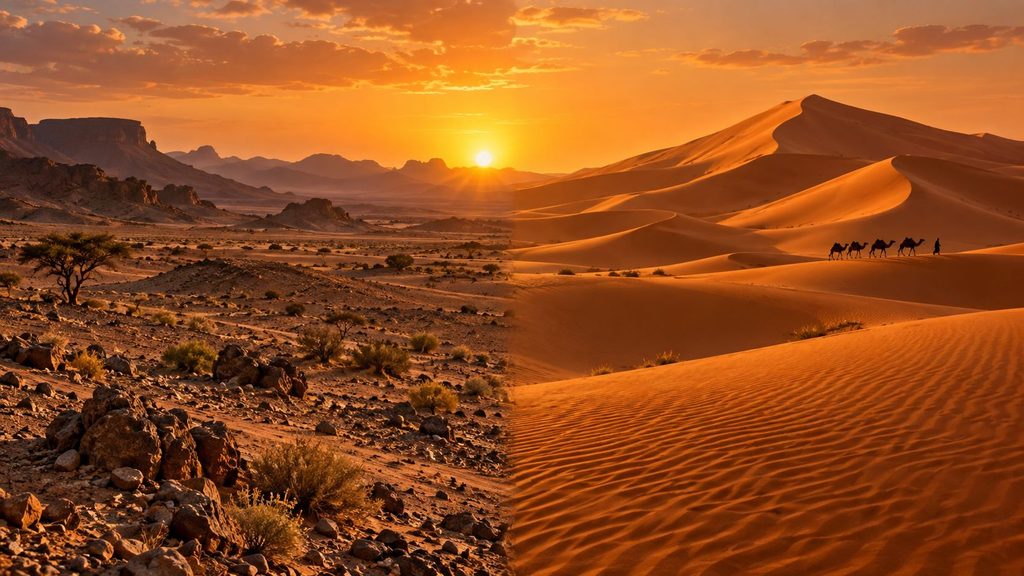
| Dune scenery | Smaller, rockier, scattered dunes | Tall golden dunes, up to ~150 m |
| Daily driving load | Very heavy both days | Split more evenly across 3 days |
| Stops en route | Fewer, shorter | Aït Ben Haddou, Dadès/Todra Gorges, Ouarzazate |
| Typical price | Lower | Higher, but more included |
| Best suited for | Time-poor travelers, short Morocco trips | First-timers, couples, photographers, anyone who wants the “real” Sahara |
What Each Tour Actually Looks Like
The 2-Day Zagora Tour
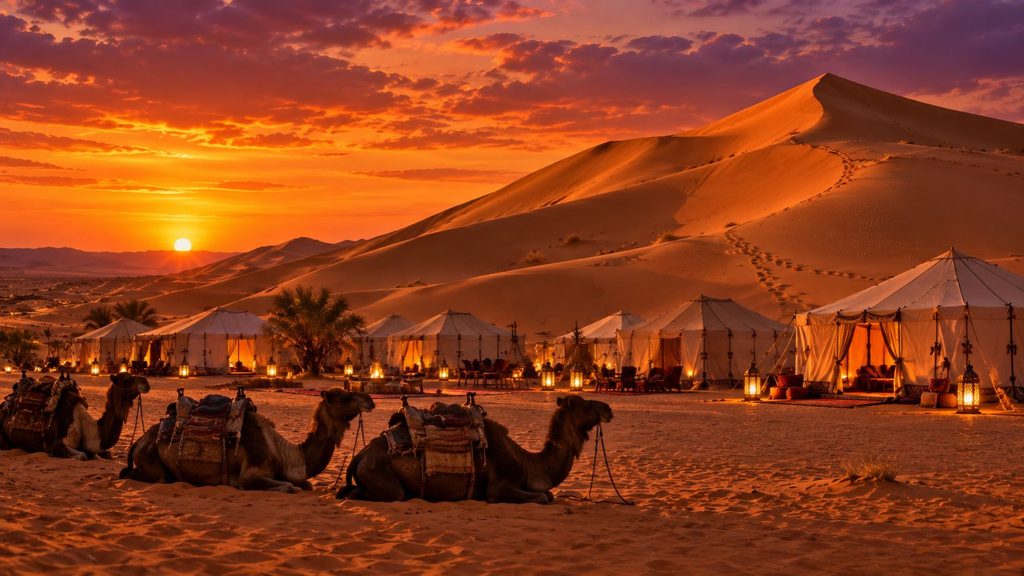
Day 1: Early pickup in Marrakech, a long drive over the High Atlas via Tizi n’Tichka, a few photo stops, arrival in the Zagora/Drâa Valley area by late afternoon, a short camel ride to camp, dinner, music, and a night under genuinely dark skies.
Day 2: Early wake for sunrise (if the light cooperates), breakfast, camel or 4×4 transfer back to the vehicle, and a long drive straight back to Marrakech.
You get roughly one afternoon, one evening, and one morning in the desert — call it 15–18 hours away from Marrakech in total, of which maybe 10–12 are actually spent at or near the camp. The rest is road.
The 3-Day Merzouga Tour
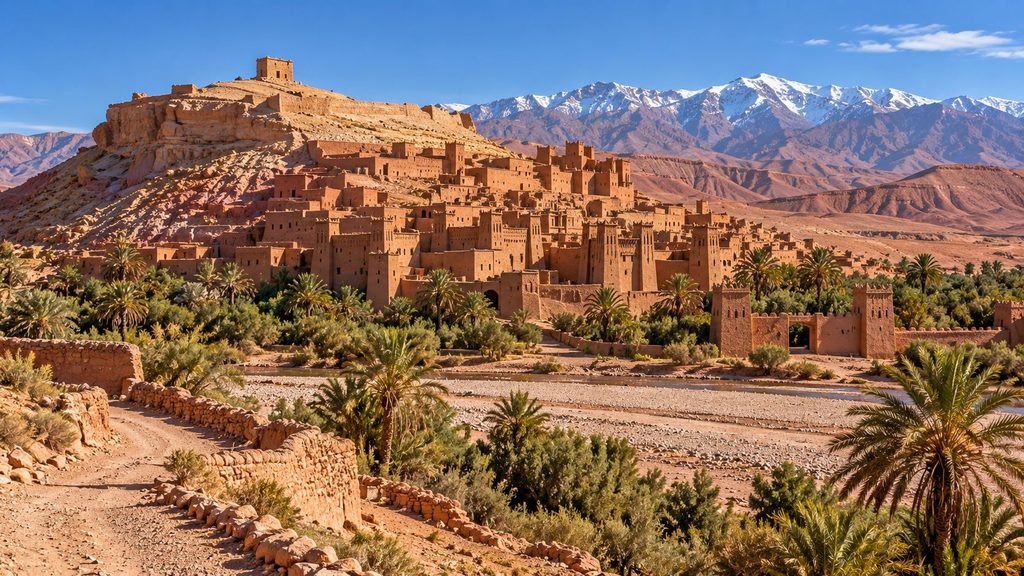
Day 1: Depart Marrakech early, cross the High Atlas, stop at the UNESCO-listed ksar of Aït Ben Haddou, continue through Ouarzazate, and overnight in a guesthouse in the Dadès or Skoura area — breaking the long drive in half.
Day 2: Continue through the Dadès and Todra Gorges, arrive at Merzouga by mid-to-late afternoon, switch to camels (or a 4×4, usually for a small supplement) for a sunset ride into Erg Chebbi, then dinner, Berber music, and a night in a desert camp beneath the dunes.
Day 3: Sunrise over the dunes, breakfast, and a scenic drive back to Marrakech, often via a different stretch of road with more time for stops.
The extra day doesn’t just add distance coverage — it changes what you actually see along the way. Aït Ben Haddou, the Dadès Valley, and Todra Gorge are genuine attractions in their own right, not just scenery out the window.
The Honest Cost Math: Price Per Hour in the Sand
Most comparison guides stop at “2 days is cheaper, 3 days is pricier.” That’s true, but it’s not the number that actually matters. What matters is how much of what you’re paying for is desert time versus transport.
Try this with any quote you get:
- Add up the total hours of the trip (departure to return).
- Subtract the hours spent driving.
- Divide the tour price by the remaining hours.
A 2-day tour often works out to a similar — sometimes higher — cost per hour actually spent in the desert, because so much of the trip is road time. A 3-day tour spreads the same fixed costs (guide, vehicle, fuel) across more usable hours and adds cultural stops that a 2-day itinerary skips entirely. It isn’t always true, and it depends on the specific quote, but it’s a far more useful way to compare two prices than looking at the total alone — and it’s worth running before you assume the cheaper option is the better value.
What You Gain (and Lose) by Cutting a Day
What the 2-day tour gives you:
- A genuine night in a desert camp, camel ride included, without committing three days of a short Morocco trip
- A lower price point
- A real taste of Berber hospitality and a sky full of stars
What it costs you:
- The Erg Chebbi dunes themselves — Zagora’s landscape is real desert, but flatter, rockier, and less dramatic
- Almost any cultural stops along the way; the drive becomes closer to a transfer than an itinerary
- Comfort — two very long driving days back to back is tiring, especially if you’re prone to motion sickness on the mountain switchbacks
What the 3-day tour adds:
- Erg Chebbi’s tall dunes, the ones that show up in every Morocco travel photo
- Aït Ben Haddou, the Dadès Valley, and Todra Gorge as genuine stops, not drive-by scenery
- A gentler pace, with the long drive broken into two more manageable legs
What it costs you:
- One more day out of your Morocco itinerary
- A higher price, though usually not double the 2-day cost
- Still only one night in the desert — if you want a full unhurried day at the dunes, that’s a case for 4 days, not 3
Who Should Book Which Tour
Choose the 2-day tour if:
- You have limited time in Morocco and can’t spare a third day
- Budget is the deciding factor
- You mainly want a genuine desert night and don’t need the tallest dunes specifically
- You’re combining this with a packed multi-city itinerary and treat the desert as one stop among several
Choose the 3-day tour if:
- Seeing the iconic Erg Chebbi dunes matters to you — for most first-time visitors, this is the whole reason to go
- You’d rather spend three comfortable, varied days than two exhausting ones
- You’re traveling as a couple, family, or small group and want stops like Aït Ben Haddou and Todra Gorge along the way
- Photography or a slower, more memorable trip is part of the point
If you’re still unsure, ask yourself one question: am I picturing tall golden dunes when I imagine this trip? If yes, that image is Erg Chebbi, and you need three days to get there. If you just want a night under the stars and can make peace with a different landscape, two days will do the job.
Does the Season Change the Decision?
Yes, more than most guides mention. A 2-day tour leaves you no buffer if the weather turns — one bad-weather night means a disappointing trip with no chance to recover it. A 3-day tour, spread across two travel legs, absorbs a rough afternoon far more easily.
The comfortable travel window is October to April, with mild days and cool, clear desert nights. Summer (June–August) is genuinely harsh in the Sahara, with daytime highs regularly above 40°C — in those months, the shorter, more rushed 2-day format is the less forgiving choice, since there’s little room to adjust the schedule around the heat.
What About 4 Days?
Worth a quick mention, since it’s the natural next question. A 4-day tour doesn’t unlock a different desert — it’s still built around Merzouga and Erg Chebbi — but it adds a second night in the dunes. That second morning, after the day-trippers and one-night groups have left, is where a lot of travelers say the trip actually settles in. If three days already sounds tight to you, four is worth pricing out before you decide.
Frequently Asked Questions
Two days is enough for a genuine desert night — camel ride, camp, stars — but only at Zagora, not at the tall-dune Erg Chebbi landscape most people picture. If reaching Merzouga specifically matters to you, two days isn’t enough; you’ll need at least three.
Merzouga’s Erg Chebbi is the classic Sahara sand sea, with dunes up to roughly 150 meters. Zagora is closer, cheaper, and quicker to reach, but its dunes are smaller and more scattered. Pick Zagora when time is the constraint; pick Merzouga when the landscape is the point of the trip.
Three days is the practical minimum to reach and enjoy Erg Chebbi. Two days can only reach Zagora. Four or five days don’t unlock a different desert — they add a second night, a slower pace, and more time for stops like Aït Ben Haddou and the Dadès Valley.
For most first-time visitors, yes — the destination itself changes, not just the schedule. You’re paying for access to Erg Chebbi and for genuine stops along the way, not simply for an extra night.
Most private tours include hotel or riad pickup, transport, a driver-guide, half-board meals (dinner and breakfast, sometimes lunch), a camel trek, and desert camp accommodation. Lunches, tips, and optional extras like sandboarding or quad biking are usually paid separately — always confirm exactly what’s included before booking.
Yes, for both lengths. A private tour costs more but lets you set your own pace, stop where you want, and skip the fixed schedule of a shared group departure — worth considering if a rushed itinerary is your main concern with the 2-day option.
Conclusion
If the tall dunes of Erg Chebbi are non-negotiable for you — and for most travelers picturing “the Sahara,” they are — book the 3-day Merzouga tour. It’s the shortest trip that reaches the landscape people actually come to Morocco to see, and it spreads the driving across a far more comfortable schedule. Save the 2-day Zagora tour for when your calendar genuinely won’t allow a third day; it still delivers a real desert night, just not the one on the postcards.
Not sure which fits your dates? [Compare our 2-day Zagora and 3-day Merzouga desert tours] or send us your travel dates and group size and we’ll map out the best option for your trip.