If you’ve never trekked a mountain in your life and you’re wondering whether Mount Toubkal is really doable for someone like you — the short answer is yes. Toubkal is one of the very few 4,000-metre-plus peaks in the world that’s genuinely built for beginners. No ropes, no ice axes, no technical climbing skills. Just a good pair of legs, the right preparation, and a licensed guide walking beside you.
That said, “beginner-friendly” doesn’t mean “easy.” At 4,167 metres, Toubkal is the highest mountain in North Africa, and thin air, long walking days, and unpredictable weather can still catch first-timers off guard. This guide covers exactly what a total beginner needs to know before attempting the summit — from fitness requirements to what the two days on the mountain actually feel like.
Is Mount Toubkal Really Suitable for Complete Beginners?
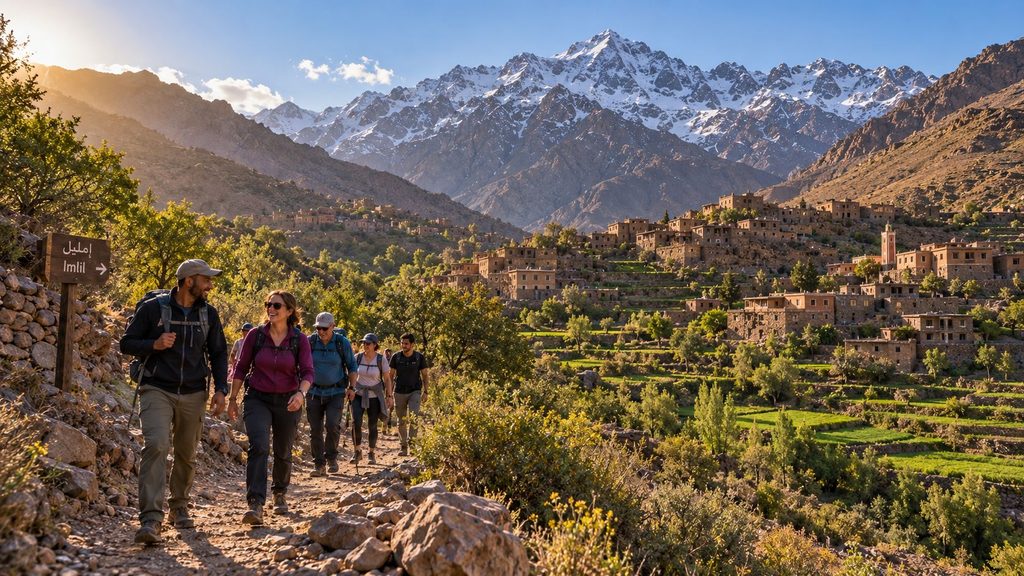
Yes — and this is the main reason Toubkal has become one of the most popular first-mountain choices for travellers passing through Marrakech. Outside of winter, the standard South Cwm route is a non-technical trek. You’re walking on rocky trails, dirt paths, and sections of loose scree rather than climbing rock faces or navigating glaciers.
What makes it accessible to first-timers:
- No technical skills needed. In summer conditions, you won’t touch a rope, crampon, or ice axe.
- Short travel time. Imlil, the trailhead village, is roughly a 90-minute to two-hour drive from Marrakech, which has an international airport.
- Guides handle the logistics. Route-finding, meals, mule transport for your bags, and refuge bookings are all arranged for you.
- Achievable in a weekend. Most first-timers summit in two days, making it realistic even on a short trip to Morocco.
What it doesn’t mean: that you can turn up unfit and untrained and expect an easy day. Toubkal is still a real mountain, and the summit push is long and physically demanding regardless of your experience level.
Do You Need a Guide?
Yes, and this isn’t optional. Since regulations tightened in the late 2010s, all trekkers inside Toubkal National Park are legally required to trek with a registered local guide, and this is checked at points along the route. For a first-timer, this is genuinely good news rather than a restriction — a guide keeps you on the correct path (the trail is easy to lose in places), paces you appropriately for the altitude, carries emergency knowledge if anyone develops altitude sickness, and arranges your refuge stay and mule support.
How Fit Do You Actually Need to Be?
You don’t need to be an athlete, but you do need a reasonable base level of cardiovascular fitness. Expect five to seven hours of walking on the approach day and a long eight-to-ten-hour summit day, much of it on an uphill gradient with a steep, tiring descent to follow.
A realistic fitness benchmark before you go:
- You can comfortably walk for 4-5 hours on hilly terrain without stopping every few minutes.
- You’ve done at least a few long walks or hikes (even flat ones) in the weeks before your trip.
- You’re comfortable climbing several flights of stairs without becoming breathless.
If you can tick those boxes, altitude and pacing become the bigger factors — not raw fitness.
What About Altitude Sickness?
This is the part beginners tend to underestimate. Toubkal isn’t in the same league as Kilimanjaro or Everest Base Camp, but sleeping at the Toubkal Refuge (around 3,200 metres) and summiting above 4,000 metres is high enough to trigger altitude symptoms — headaches, nausea, or fatigue — in people who’ve never experienced them before.
The good news: a two-to-three-day itinerary with a proper acclimatisation stop and an experienced guide setting a slow, steady pace on summit day significantly reduces the risk. Drink more water than feels necessary, avoid alcohol the night before, and tell your guide immediately if you start feeling unwell — don’t push through it.
The Standard Route: What the Two Days Actually Look Like
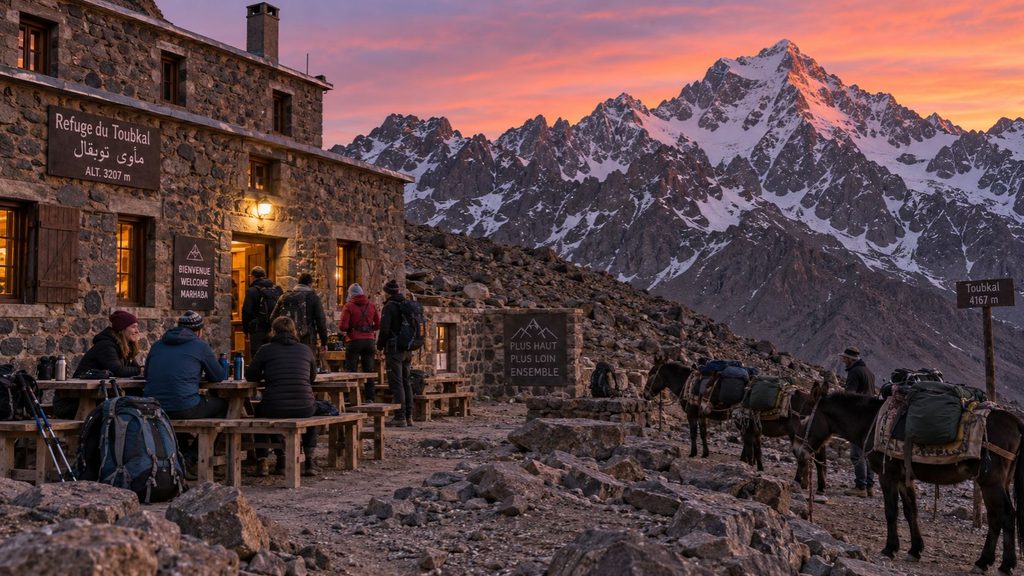
Day 1: Imlil to the Toubkal Refuge You’ll drive from Marrakech to Imlil, meet your guide, and begin walking. The trail climbs steadily through Berber villages and the Mizane Valley before reaching the Toubkal Refuge at roughly 3,200 metres — a five-to-six-hour walk. Mules typically carry your main bag, so you’re only walking with a light daypack. You’ll rest, eat, and sleep at the refuge to acclimatise before summit day.
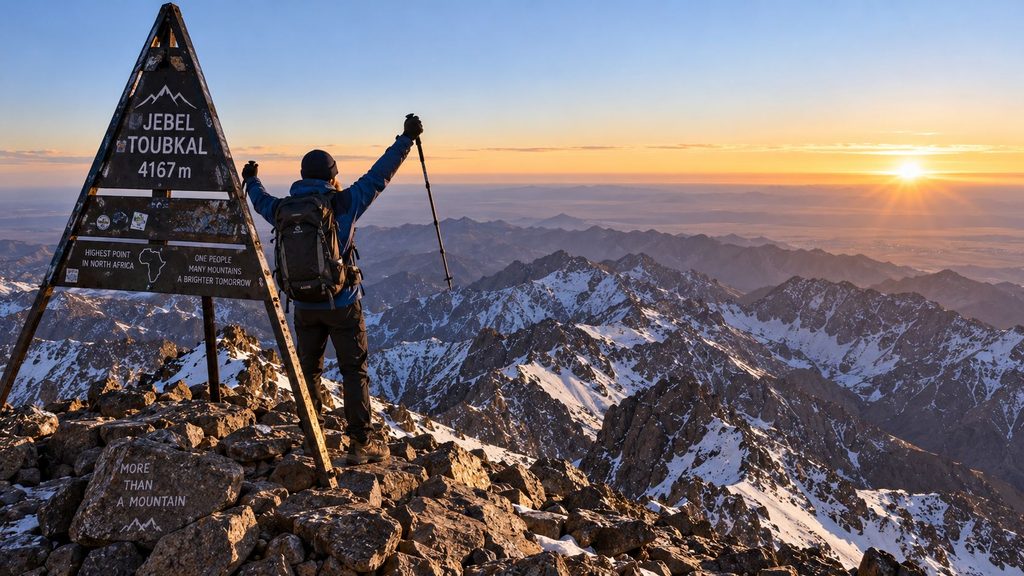
Day 2: Refuge to Summit and Back to Imlil This is the long day. You’ll set off early — often before sunrise — and climb roughly 1,000 vertical metres over loose scree and a steep, zigzagging path toward the saddle between the peaks. From there, the final push to the 4,167-metre summit takes you through increasingly thin air. The reward is a 360-degree view stretching toward the Sahara on a clear day. You then descend all the way back to Imlil in the same day, making for a demanding but hugely satisfying finish.
What to Pack as a First-Timer
You don’t need specialist mountaineering gear, but a few essentials make a real difference:
- Sturdy, worn-in hiking boots with ankle support — not trainers, and definitely not new boots straight out of the box.
- Layered clothing — temperatures swing dramatically between the valley and the summit, and it can be well below freezing at sunrise even in summer.
- A warm hat, gloves, and a proper jacket for the exposed summit ridge.
- A headtorch for the early summit-day start.
- Trekking poles — genuinely useful on the scree and on the knee-jarring descent.
- Sun protection — altitude sun is stronger than it feels.
- A refillable water bottle or hydration bladder, plus water purification tablets if you’re not buying bottled water at the refuge.
Best Time of Year for a First Attempt
For a beginner, late spring through early autumn (roughly May to September) offers the most forgiving conditions — no snow or ice on the trail, meaning the whole route stays non-technical. Climbing in winter is possible but requires crampons, an ice axe, and genuine mountaineering experience, so it’s not the right season for a true first-timer.
Final Word for First-Time Climbers
Mount Toubkal earns its reputation as one of the best “first big mountain” experiences in the world because it strips away almost every technical barrier and leaves you with the one thing that actually matters for a beginner: a serious physical challenge you can prepare for. Go in reasonably fit, book a mount toubkal trek with a licensed guide, respect the altitude, and pace yourself on summit day — and there’s no reason a complete beginner can’t stand on the roof of North Africa within 48 hours of leaving Marrakech.
Frequently Asked Questions
Yes. Outside of winter, the standard route is non-technical and doesn’t require any prior climbing or mountaineering experience — just reasonable fitness and a licensed guide.
Yes, it’s a legal requirement to trek with a registered local guide inside Toubkal National Park, and this is enforced at checkpoints along the route.
Most trekkers, including first-timers, complete it in two days, though a three-day itinerary allows for a more relaxed pace and better acclimatisation.
In summer, no technical equipment like ropes, crampons, or an ice axe is needed. Sturdy hiking boots, layered clothing, and trekking poles are enough.
It’s possible, since the refuge sits at around 3,200 metres and the summit is at 4,167 metres. Mild symptoms like headaches are common; staying hydrated, pacing slowly, and listening to your guide reduce the risk significantly.