If you’ve typed “Marrakech to Merzouga 3 day tour” into Google, you’ve probably landed on a dozen near-identical booking pages; same photos, same “unforgettable Sahara adventure” copy, and very little information about what the trip actually involves.
This guide skips the sales pitch and gives you what you actually need to plan: the day-by-day route, realistic 2026 costs, what is usually included, and the mistakes that catch first-time travelers out.
Quick Answer
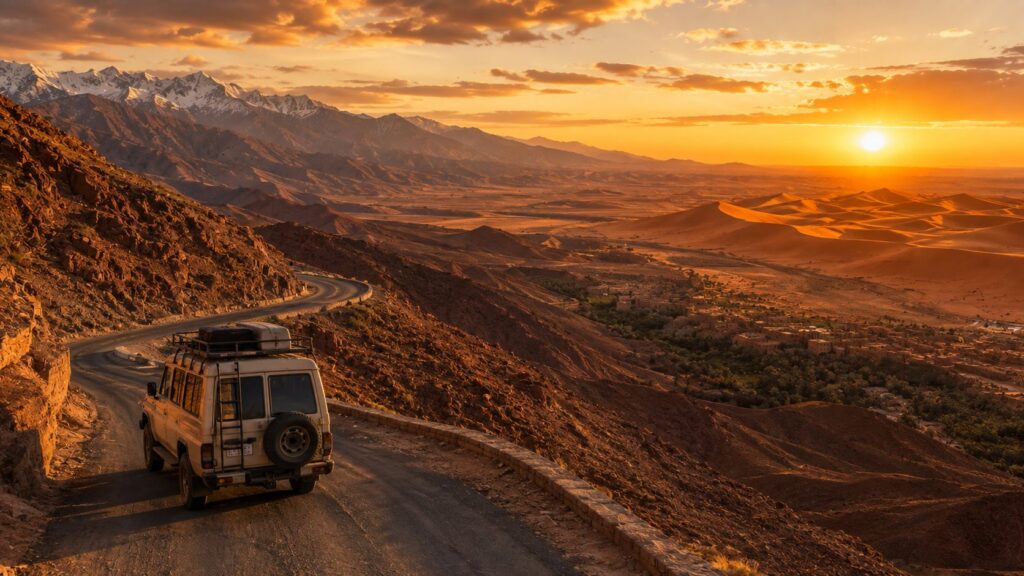
A Marrakech to Merzouga 3-day desert tour is a 2-night trip covering the High Atlas Mountains, Aït Ben Haddou, the Dades Valley, Todra Gorge, and the Erg Chebbi dunes near Merzouga. The total driving distance is roughly 1,100–1,200 km round trip, depending on the route and stops.
As a general planning range, shared group tours often cost around €95–200 per person, while private tours can range from roughly €200 to €800+ per person, depending on group size, vehicle, accommodation, and desert camp standard.
Expect around 5–7 hours of driving on Days 1 and 2, with Day 3 usually being the longest driving day at around 8–10 hours including stops.
The trip is absolutely doable in three days, but it is not a relaxed itinerary. You’re covering a lot of Morocco in a short time.
Day-by-Day Itinerary
Day 1: Marrakech → Aït Ben Haddou → Dades Valley
Pickup from your riad or hotel is usually between 7:00 and 8:00 AM.
The route climbs over the Tizi n’Tichka pass, at around 2,260 metres, through the High Atlas Mountains. You’ll usually have opportunities to stop at viewpoints and small villages along the way, and some tours include a visit to a local cooperative.
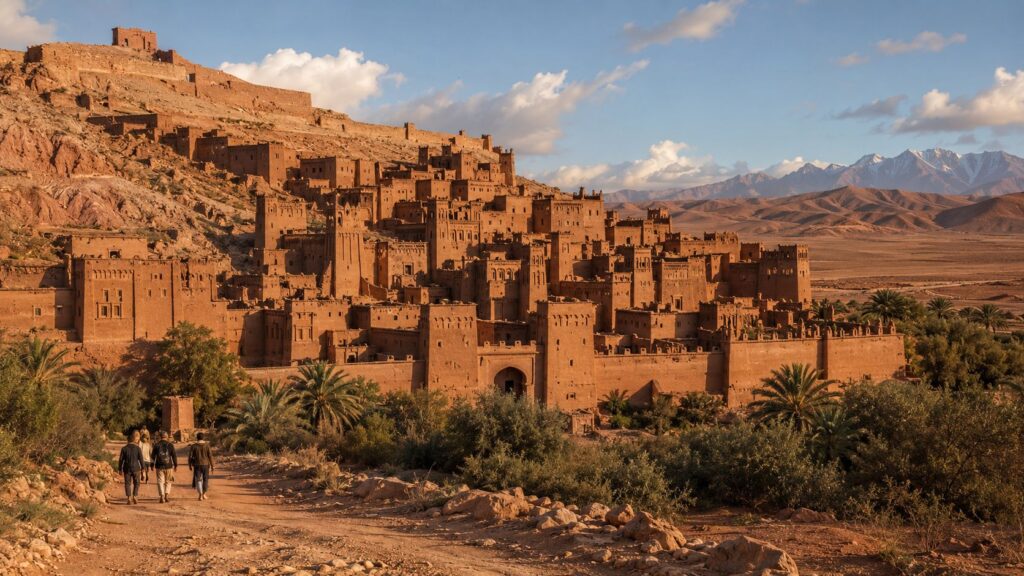
Continue toward Aït Ben Haddou, the famous fortified ksar and UNESCO World Heritage Site. Allow roughly 45–60 minutes to explore the old village on foot, although a longer visit is better if your itinerary allows it.
After lunch, the journey continues through Ouarzazate, sometimes called the gateway to the Sahara and well known for its film studios.
From there, you’ll head east through the Valley of Roses and Dades Valley, following sections of the famous Road of a Thousand Kasbahs.
The day normally ends at a hotel or guesthouse in the Dades area, with dinner and an overnight stay.
Typical driving time: around 5–7 hours, excluding sightseeing and meal stops.
Day 2: Dades Valley → Todra Gorge → Merzouga
Day 2 starts with a journey toward Todra Gorge, one of the most dramatic landscapes on the route to Merzouga.
The gorge is surrounded by towering limestone cliffs and is a popular stop for walking and photography. Even a short walk gives you a chance to stretch your legs after the previous day’s driving.
From Todra, the road continues through small towns, palm-filled oases and desert landscapes as you make your way toward Merzouga.
You should arrive in the Merzouga area in the afternoon.
Later, you’ll leave your vehicle and travel into the Erg Chebbi dunes, traditionally by camel, for sunset. The camel ride generally takes around 45–60 minutes, depending on the camp location and conditions.
At camp, you’ll have dinner and usually some form of traditional music or drumming around the fire. If the weather is clear, the Sahara night sky can be one of the highlights of the entire trip.
Typical driving time: around 4–6 hours, excluding stops.
Day 3: Merzouga → Marrakech
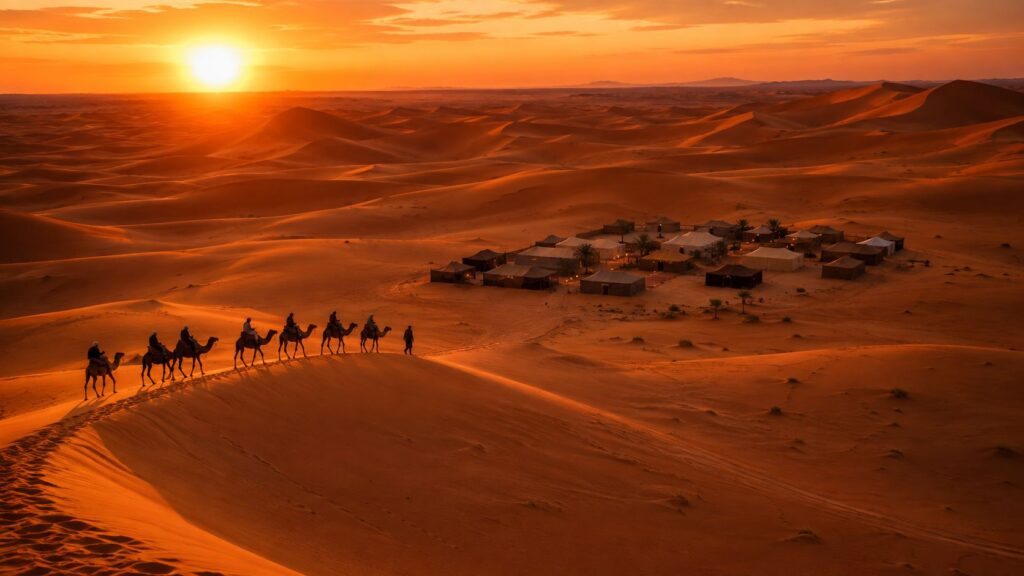
If you’re willing to wake up early, Day 3 starts with one of the best experiences of the trip: sunrise over the Erg Chebbi dunes.
After breakfast, you’ll return from the camp and begin the long journey back toward Marrakech.
The exact return route varies by tour operator. Some itineraries retrace the route through Ouarzazate and the High Atlas, while others use sections of the Draa Valley before continuing west.
Either way, this is the longest driving day.
Plan for roughly 8–10 hours in the vehicle including stops, and don’t be surprised if you arrive back in Marrakech in the early evening.
This is the biggest trade-off of choosing a 3-day itinerary: you get to experience Merzouga and spend a night in the Sahara, but the return journey is long.
What’s Usually Included — and What Isn’t
Most 3-day Marrakech to Merzouga tours include:
- Transport in an air-conditioned minibus, van or 4×4
- An English-speaking driver or driver-guide
- One night in a hotel or guesthouse
- One night in a desert camp
- Breakfast and dinner
- Camel trekking or another transfer into the desert camp
- Basic sightseeing stops along the route
However, always check the individual tour’s inclusions before booking.
Things that are commonly not included include:
- Lunches
- Drinks and bottled water
- Optional local guides
- Certain attraction or activity fees
- Tips for drivers, guides and camp staff
- Travel insurance
- Personal expenses
Lunches at tourist stops can commonly cost around 50–100 MAD (€5–10), although prices vary by restaurant and what you order.
What It Actually Costs in 2026
There is no single standard price for a Marrakech to Merzouga 3-day tour.
The biggest factors are group size, vehicle type, season, accommodation and desert camp standard.
As a realistic planning guide, you can expect roughly:
- Shared/group tour, standard camp: €95–200 per person
- Private tour, standard-to-mid-range accommodation: €200–450 per person
- Private tour with a higher-end/luxury desert camp: €450–800+ per person
These are broad planning ranges rather than fixed market prices. Quotes can be higher or lower depending on the dates, number of travelers, accommodation and exactly what is included.
Why Can Two Tours Have Such Different Prices?
A €100 shared tour and a €400 private tour may appear to offer the same itinerary on paper, but they can be very different experiences.
Ask what you’re actually getting:
- How many people will be in the vehicle?
- Is it a minibus, van or private 4×4?
- Is the accommodation private or shared?
- Does the desert tent have a private bathroom?
- Is there a proper bed?
- Is electricity available?
- Is the camp heated or cooled?
- Are meals included?
- Is the driver also your guide?
- Are there additional stops or activities?
The word “luxury” isn’t a regulated category, so don’t rely on the label alone.
A better approach is to ask exactly what the camp provides.
7 Mistakes to Avoid
1. Underestimating the Driving
This is not a slow-paced desert holiday.
You’re crossing a large part of Morocco in only three days, and Day 3 can involve 8–10 hours of driving.
If you get carsick easily, are traveling with young children, or simply dislike long road journeys, consider a longer itinerary.
2. Not Packing an Overnight Bag
Your main luggage will normally remain with the vehicle while you head into the desert camp.
Pack a small daypack with:
- A change of clothes
- Toothbrush and toiletries
- Warm layers
- Phone charger/power bank
- Medication
- Any other essentials you’ll need overnight
Don’t wait until you reach Merzouga to realize your jacket is buried inside your main suitcase.
3. Packing Only for Hot Weather
The Sahara can be extremely hot during the day and surprisingly cold after sunset.
Even outside winter, temperatures can drop significantly at night.
Pack layers: a lightweight base layer, warm mid-layer and jacket or fleece. Sunscreen, sunglasses and a hat are just as important during the day.
4. Confusing “Shared” and “Private”
A shared tour might have a small group, but group sizes vary between operators.
If you want to stop whenever you like, spend longer at a viewpoint or adjust the pace around your interests, a private tour gives you considerably more flexibility.
If price is your main priority, shared is usually the better option.
5. Booking on Price Alone
A very cheap tour isn’t necessarily a bad tour — and an expensive tour isn’t automatically a good one.
Compare the details.
In particular, check the camp standard, vehicle, group size and accommodation rather than comparing only the headline price.
6. Assuming the Desert Camp Works Like a Hotel
Some camps have private bathrooms, comfortable beds, electricity and surprisingly good facilities.
Others are much more basic.
Wi-Fi may be limited or unavailable, electricity may depend on generators or solar power, and water can be more restricted than you’re used to in a hotel.
Go in expecting a desert experience rather than a conventional hotel stay.
7. Not Finding Out Who Actually Operates the Tour
If you book through a large marketplace or intermediary, you may ultimately be traveling with a local Moroccan operator.
Before paying, find out:
- Who is operating the trip?
- Who will be driving?
- What type of vehicle will you use?
- How large is the group?
- Which camp will you stay at?
Knowing these details can tell you much more about the experience than a polished booking-page description.
Packing List Essentials
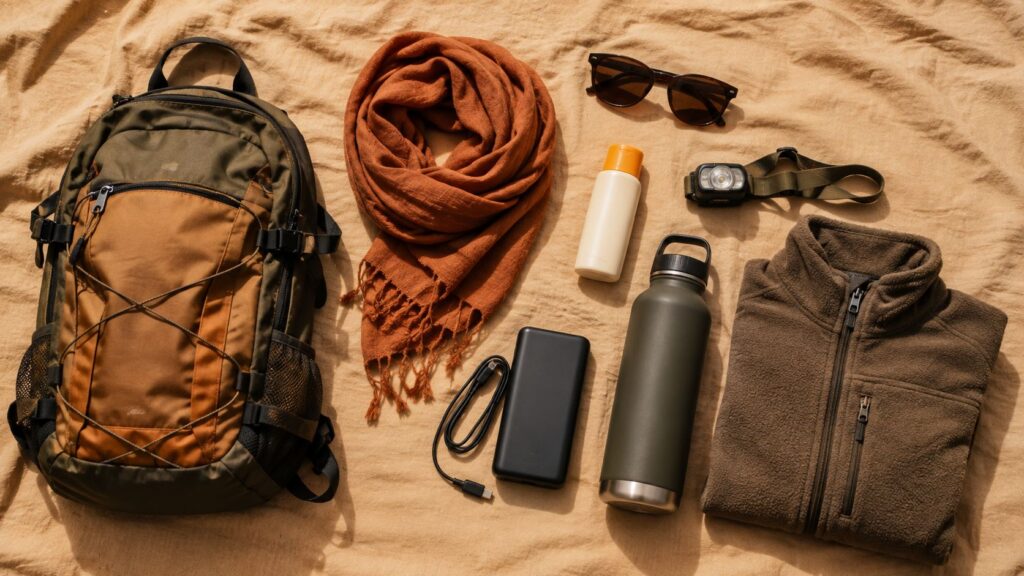
You don’t need to overpack for a three-day Sahara tour.
Bring:
- Lightweight, layered clothing
- A warm fleece or jacket
- Comfortable closed walking shoes
- Hat or cap
- Sunglasses
- High-SPF sunscreen
- Small daypack
- Headtorch
- Power bank
- Cash in small denominations
- Reusable water bottle
- Personal medication
- Motion-sickness medication if you are sensitive to winding mountain roads
A scarf or buff can also be useful for sun, wind and dust.
Most importantly, keep the items you’ll need at the desert camp in a small overnight bag rather than inside your main luggage.
FAQ
Yes, but it’s the minimum I’d recommend if you want to reach Merzouga and spend a night in the Erg Chebbi dunes.
You’ll see a lot in three days, but you’ll also spend significant time on the road.
If you have four or more days, the journey becomes considerably more relaxed
Merzouga is roughly 560 km from Marrakech by road, although the actual distance depends on the route taken.
Driving directly would take many hours, which is why a three-day tour breaks the journey into multiple sections with an overnight stay around the Dades Valley.
For comfortable desert temperatures, February–April and September–November are generally good periods to consider.
Summer can be extremely hot, with daytime temperatures in the desert sometimes exceeding 40°C.
Winter can be pleasant during the daytime but cold at night, particularly in December and January.
It depends on what matters most to you.
Choose shared if: you want the lowest price and don’t mind traveling with other people.
Choose private if: you want your own vehicle, more flexibility, a more personal experience, or you’re traveling as a family or group of friends.
For couples and families, the additional cost of a private tour can be worthwhile simply because you have more control over the pace.
Usually, yes, but don’t assume every tour includes exactly the same experience.
Some operators include a traditional camel trek to the camp, while others may offer a shorter camel experience and vehicle transfer.
Check the itinerary before booking if the camel ride is important to you.
It is possible to find two-day itineraries, but I wouldn’t recommend them if your goal is to properly experience Merzouga.
The distances are substantial, and a two-day schedule usually means spending much of the trip in the vehicle.
Three days gives you enough time to see the main stops and spend a night in the Erg Chebbi dunes, although it is still a fast-paced trip.
Conclusion: Is the 3-Day Tour Worth It?
For travelers with limited time in Morocco, yes.
A Marrakech to Merzouga 3-day tour lets you experience several very different landscapes in one trip: the High Atlas, Aït Ben Haddou, the valleys around Ouarzazate and Dades, Todra Gorge and, finally, the Sahara dunes around Merzouga.
The trade-off is simple: you save time, but you spend more time driving.
If you have only a few days and reaching the Sahara is a priority, three days is a practical compromise.
If you have more time, adding another day or two will make the journey considerably more relaxed.
Planning your own Marrakech to Merzouga trip? We build private and small-group Sahara desert itineraries around your dates and preferred pace rather than forcing every traveler into the same schedule.
Get in touch on WhatsApp and tell us your dates, group size and preferred level of accommodation. We can help you work out the right route and desert camp for your trip.